
GOOGL Revenue Hits $385 Billion as Google Expands Control Across AI Stack
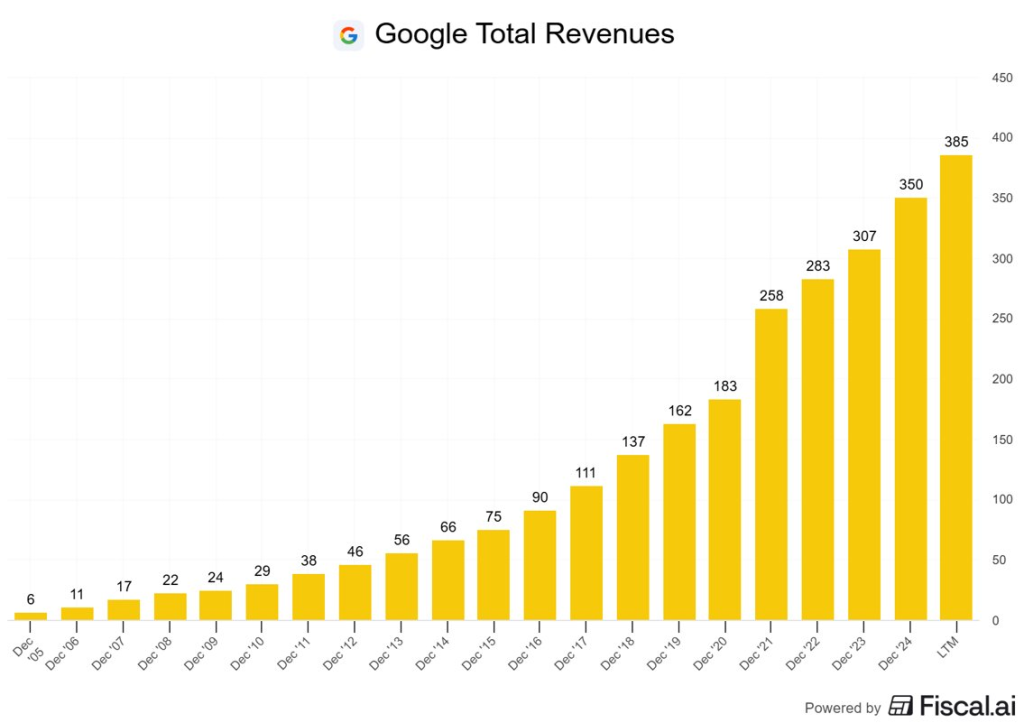
- Google (GOOGL) just posted total revenues of $385 billion on a trailing basis, and the numbers keep climbing. Back in 2005, the company was pulling in just $6 billion—now we’re looking at almost two decades of serious scaling across every product category and market you can think of.
- Here’s what makes Google’s position interesting right now: they’re controlling the entire AI stack from top to bottom. They’re training their frontier systems on proprietary TPU silicon, which means they’re not paying the markup that everyone else in the industry has to deal with. That’s a massive cost advantage on compute, and it’s already getting attention—Meta and Anthropic are both in talks to buy TPU capacity.
- The data side is where things get really powerful. Search, YouTube, Maps, Gmail, Chrome, Android—all of it feeds real-time behavioral data straight into model training. “AI enhancements are strengthening Search, accelerating adoption trends in Google Cloud and expanding monetization potential within YouTube,” highlighting how these systems work together.
- Then there’s Gemini 3, trained entirely on Google’s own chips and pushed across every major product surface. Instead of creating new risks, AI is basically supercharging the growth trajectory of Google’s core businesses. And the distribution layer? Absolutely crushing it. Google can deploy new AI features instantly to billions of users through platforms they already own.
- The combination of rising revenues and full-stack AI integration shows exactly how Google’s scale shapes its competitive position. They control the silicon, the data, the models, and the distribution—all inside one ecosystem. The revenue chart tells the story: financial momentum and AI expansion are moving in lockstep.
My Take: Google’s integrated approach is the real differentiator here. While competitors scramble for compute and partnerships, Google’s building everything in-house and deploying at scale. The $385 billion revenue milestone isn’t just growth—it’s validation.
Source: Shay Boloor


 English