
SPX News: Retail Investors Buy S&P 500 Selloffs at Record Pace
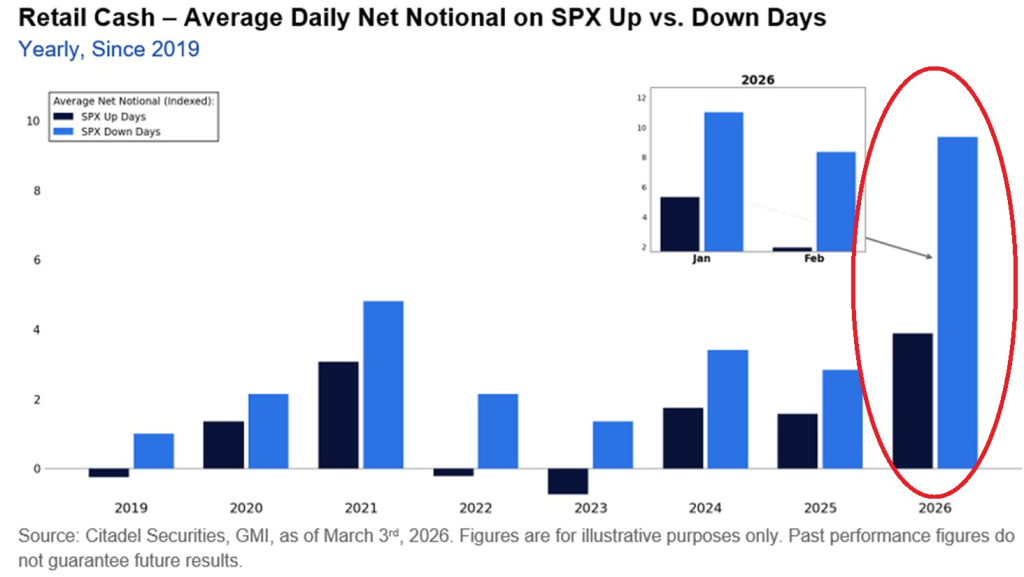
Retail trading activity in the SPX market has surged to unprecedented levels in 2026, with individual investors increasingly buying during market declines. New data shows that retail traders are purchasing equities during S&P 500 down days at the highest average daily level on record.
As Global Markets Investor reported, the magnitude of dip buying by individual investors now exceeds the levels seen during the 2021 meme stock surge, highlighting a significant shift in how retail participants interact with market volatility.
Dip Buying Activity Shows a Strong Imbalance
The chart highlights a striking imbalance between buying activity on rising and falling market sessions. In February 2026, retail investors bought equities during S&P 500 down days at a rate 4.3 times higher than during up days, a sharp increase from 2.1 times in January.
The scale of these purchases is also roughly twice as large as the peak retail activity observed during the 2021 meme mania, indicating that individual traders continue to aggressively buy market selloffs. At the same time, broader market concerns are emerging as S&P 500 valuations approach 40x as the CAPE ratio nears historic highs, raising questions about how sustainable current equity prices may be if macro conditions tighten.
Retail Traders Increase Activity in Options Markets
Retail participation has expanded beyond equities into derivatives markets as well. Average daily retail options trading volume in 2026 is 14% higher than in 2025 and 47% above the average levels recorded between 2020 and 2025.
This surge in derivatives activity reflects continued engagement from individual traders during periods of market volatility. However, some technical indicators are beginning to flash warnings as S&P 500 bearish divergence as technology stocks begin to lag emerges across major indices.
Retail Demand Becomes a Key Force in SPX Market Structure
The trend of aggressive dip buying by retail traders has become a defining feature of the S&P 500 market environment in 2026. Despite elevated valuations and growing macro uncertainty, individual investors continue to treat pullbacks as buying opportunities. This persistent retail demand is increasingly shaping market dynamics, particularly during periods of weakness. However, risks remain if institutional positioning shifts. Analysts warn that S&P 500 facing potential $80B systematic selling risk from CTAs could amplify downside volatility if systematic funds begin reducing exposure.
My Take: Retail investors buying dips at record levels is a double edged signal. On one hand, it creates a real demand floor under the market. On the other hand, if institutional selling accelerates, individual traders absorbing that pressure could face significant losses quickly.
Source: Twitter Post by Global Markets Investor


 English