
S&P 500 Stock News: Bearish Divergence as Tech Lags
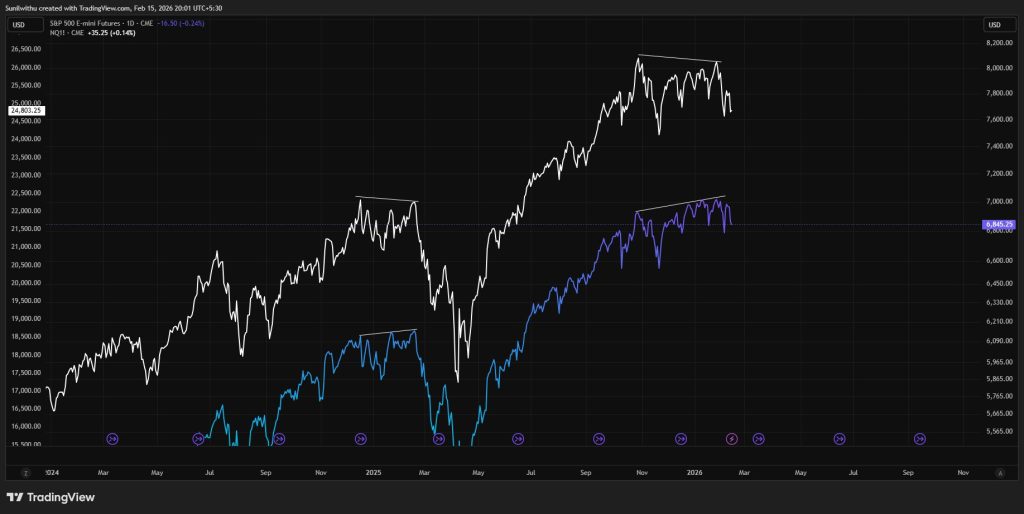
The S&P 500 has recently pushed to a fresh higher high, maintaining the appearance of strength in headline index performance. However, beneath the surface, market structure tells a different story. Technology stocks — traditionally the primary growth engine of U.S. equities — have formed a lower high, failing to confirm the broader index breakout.
This developing divergence suggests narrowing internal participation and raises questions about the sustainability of the current rally.
Key Market Signals
Higher High in the S&P 500
S&P 500 futures have continued grinding upward, establishing new highs and reinforcing the perception of ongoing bullish momentum. On the surface, trend structure remains intact, and price action alone does not yet signal a breakdown. However, leadership quality is just as important as price direction, particularly during mature stages of a rally.
Tech Sector Forms a Lower High
In contrast to the broader index, the tech-heavy benchmark has failed to register a comparable breakout and has instead formed a lower high — a classic warning sign in structural analysis. When the primary growth engine of the market does not confirm new highs, it often indicates that upside momentum is narrowing beneath the surface. Historically, this type of divergence tends to appear in late-stage rallies when breadth begins to thin and leadership rotates more defensively before broader weakness emerges.
Why This Bearish Divergence Matters
A divergence between the S&P 500 and technology leadership does not guarantee immediate downside. However, it frequently precedes periods of heightened volatility and tightening liquidity conditions. As capital becomes more selective, high-beta and cyclical segments often weaken first, followed by broader index pressure. In such environments, headline indices can appear stable while internal participation deteriorates quietly.
If this divergence expands into a wider correction, the macro implications could extend beyond equities. Liquidity stress typically drives defensive positioning and can contribute to upward pressure in the Gold/Silver ratio, as silver tends to underperform gold during risk-off phases. This dynamic reflects tightening financial conditions and a shift toward capital preservation.
Outlook for Equities
For now, the S&P 500 trend remains technically intact on the surface. Nevertheless, the failure of technology stocks to confirm new highs introduces asymmetric risk into the current setup. Structural weakness often develops gradually before becoming visible in price action. Monitoring participation, leadership rotation, and internal breadth will be essential in determining whether this divergence remains contained or evolves into broader market pressure.
Analyst Perspective
This bearish divergence represents a classic late-cycle signal that warrants caution. While headline indices can continue grinding higher on increasingly narrow leadership, history suggests that such setups rarely persist without an eventual increase in volatility. Investors should focus not only on index levels but also on the quality of participation supporting the advance.



 English