DeepSeek’s New AI Model Claims 25× Cost Edge Over GPT-5
- DeepSeek just dropped its newest open-source model, DeepSeek-V3.2, and the numbers are turning heads. The company says it’s achieved a massive leap in both efficiency and capability, especially when it comes to reasoning, coding, and multi-step problem solving. They’re calling it a “gold-medal level” system, comparing its performance to what you’d expect from winners of top global competitions like IMO, IOI, and ICPC. The research paper backing it up positions DeepSeek-V3.2 as a serious challenger, getting close to GPT-5-High performance in several key areas.
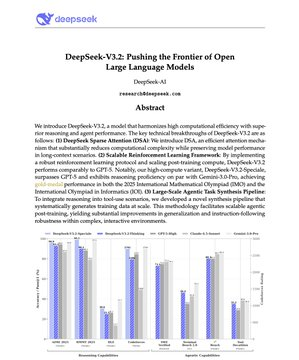
- The DeepSeek-V3.2-Speciale version is reportedly beating Gemini 3.0 Pro across multiple math and coding benchmarks. But here’s where it gets really interesting—the model’s output tokens cost about 25 times less than GPT-5 and roughly 30 times cheaper than Gemini 3 Pro. In an industry where inference costs can make or break a business case, that’s a game-changer. The secret sauce appears to be DeepSeek Sparse Attention, which cuts down long-context computation costs dramatically while still letting the model scale up without eating through resources.
- What really sets DeepSeek apart is how heavily they’ve leaned into reinforcement learning. According to the research, over 10 percent of their entire pre-training budget went into RL—way more than what you typically see in open-source projects. As the team noted in their paper, “More than 85,000 agent tasks and 1,800 synthetic environments were used in the development process.” That’s one of the most extensive agent-focused training pipelines ever shown in public research. These environments weren’t just for show—they helped tune the system’s behavior, coordination, and problem-solving efficiency in ways that traditional training methods don’t really touch.
- This release matters because it challenges a pretty common assumption: that only big proprietary labs can deliver frontier-level performance. DeepSeek is showing competitive benchmark results at a fraction of the cost, which puts pressure on everything from AI infrastructure to chip demand and cloud economics. As model efficiency keeps improving and hardware requirements shift, we might be looking at a real change in how enterprises think about adopting AI—and what they can expect from open-source systems.
My Take: DeepSeek’s cost advantage could democratize high-performance AI access, but the real test will be production reliability and whether these benchmarks hold up in real-world applications beyond synthetic environments.
Source: Ask Perplexity

 English