
Diesel Prices Break $5 Per Gallon in 2026, Raising Supply Chain Cost Concerns
Diesel prices have become a major focus for economists and logistics analysts in 2026 as fuel costs move significantly higher. Because diesel powers freight transportation, heavy equipment, and large parts of the industrial economy, price movements often act as an early signal of broader cost pressures.
The recent move above $5 per gallon is raising new concerns about supply chain stability and the possibility of renewed inflation risks. Market observers note that diesel often reacts more directly to industrial demand and freight activity than gasoline, making it an important indicator for economic trends.
Diesel Prices Move Above Key Economic Threshold
Diesel prices across the United States have climbed above the $5 per gallon level, creating renewed concerns about rising supply chain costs. The fuel remains essential to freight transport, shipping infrastructure, and distribution networks, making it a core component of business operating expenses.
Recent data shows diesel prices rising faster than regular gasoline, with the spread between the two fuels expanding significantly. This divergence highlights the different market forces that influence diesel, including freight demand, refinery output, and regional supply constraints.
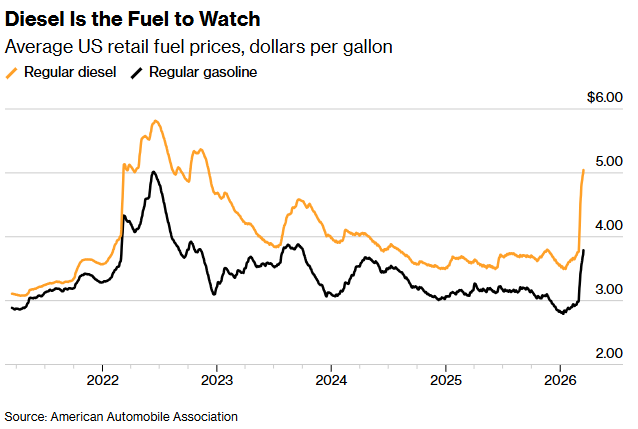
According to data from the American Automobile Association, diesel prices have surged from approximately $3.50 to more than $5.00 per gallon in early 2026. During the same period, gasoline prices remained mostly between $3.00 and $4.00 per gallon.
Supply Chain Impact and Business Cost Pressure
Diesel remains a critical economic input because it powers much of the transportation infrastructure supporting modern supply chains. When diesel prices rise sharply, industries with fuel intensive operations typically experience immediate cost increases.
Sectors such as trucking, agriculture, and manufacturing are especially sensitive to fuel price volatility. Many companies respond by introducing fuel surcharges or adjusting pricing models to protect margins.
Similar cost pass through dynamics can also be seen in commodity markets. For example, rising input costs often appear in discussions about gold inflation hedge strategies, where commodity price movements influence expectations around macroeconomic stability.
Energy Volatility and Commodity Market Signals
Because diesel plays a central role in both production and distribution systems, it is often viewed as a forward looking economic signal. When fuel costs remain elevated, their effects typically spread across multiple sectors of the economy.
The current price environment demonstrates how volatility in energy markets can translate into broader cost pressures. Comparable trends can also be observed in gold macro volatility discussions , where analysts track how commodity cycles influence economic expectations.
Inflation Risks and Market Outlook
With diesel prices remaining above $5 per gallon and no clear signs of a near term pullback, both businesses and consumers are monitoring whether these cost pressures could translate into broader inflation trends.
Because diesel is directly tied to the cost of moving goods, sustained price increases could eventually affect shipping rates, retail pricing, and industrial production costs.
Market commentator Walter Bloomberg summarized the situation in a recent social media post:
Diesel breaking $5 is not just a pump price story, it is a supply chain cost signal. When fuel that moves nearly everything gets this expensive, businesses start passing costs forward. Watch for it to show up in shipping rates and product prices soon.
Source: Twitter post by Walter Bloomberg



 English