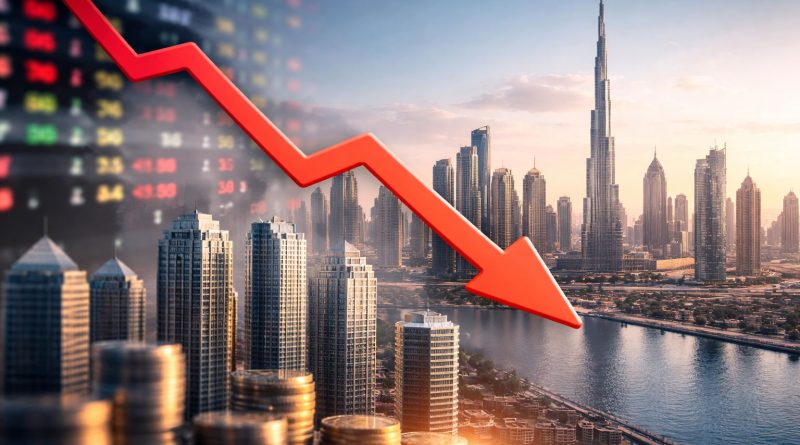
DFM Real Estate Index News: Dubai Property Stocks Slide Sharply
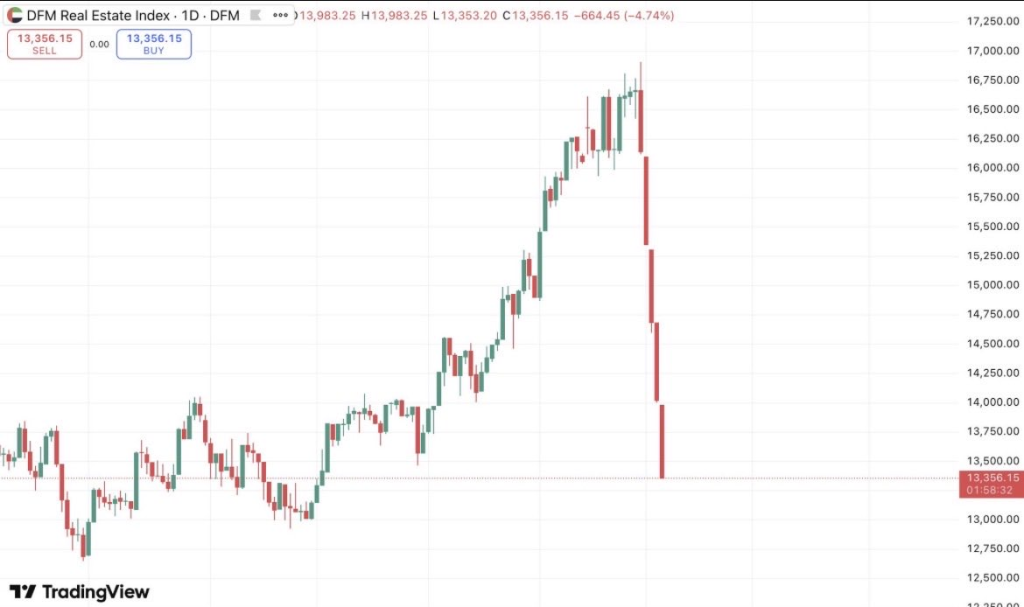
The DFM Real Estate Index has recently experienced a significant decline after a strong rally earlier in the year. Market data shows the index falling from a recent peak near 16,700 to approximately 13,356 within several trading sessions. The move represents a sharp reversal following months of steady gains in Dubai’s property-linked equities.
The chart structure reflects accelerating selling pressure, with several large red candles appearing in succession. Such rapid shifts in market structure often indicate a transition from bullish momentum to a phase of heightened volatility.
Sharp Reversal in the DFM Real Estate Index
The decline in the DFM Real Estate Index has drawn attention from analysts and market participants. According to Pumpius, the sudden downturn may reflect emerging stress within Dubai’s property sector.
Several structural factors are being discussed by analysts. These include growing supply in newly launched property developments, rising global interest rates that affect financing conditions, and a gradual weakening of buyer sentiment in parts of the market.
These dynamics have historically played an important role in property market corrections. At the same time, financial innovation is beginning to reshape how real estate assets are represented and traded globally. Recent commentary such as XRP Ledger surpasses Solana with $100M in RWA tokenization value highlights how blockchain-based real world asset tokenization is increasingly intersecting with traditional property markets.
Geopolitical Pressure and Market Sentiment
The current decline is also unfolding during a period of broader geopolitical uncertainty in the region. Regional tensions and economic disruptions have influenced investor sentiment across Gulf financial markets.
Reports indicate that UAE equities have faced noticeable pressure in recent sessions as geopolitical developments affected trading activity and market confidence. These external factors can amplify volatility in sector-specific indices such as the DFM Real Estate Index, particularly when investor positioning becomes more defensive.
Digital Asset Infrastructure and Market Evolution
While traditional property equities are currently facing pressure, technological developments in financial infrastructure continue to gain traction. Blockchain ecosystems designed to support tokenized assets and decentralized trading platforms are expanding their activity levels.
For example, XRP Ledger DEX activity surpasses 1 million transactions in January 2026 demonstrates growing participation in decentralized financial networks. These developments illustrate how digital infrastructure is gradually becoming part of the broader asset trading landscape.
Although the DFM Real Estate Index currently reflects stress within traditional property markets, long term shifts in asset ownership models and trading mechanisms may play an increasing role in shaping global financial systems.
Conclusion
Dubai’s property-linked equities are currently undergoing a sharp correction after an extended period of gains. The rapid drop in the DFM Real Estate Index highlights a combination of sector-specific pressures, macroeconomic factors, and geopolitical uncertainty affecting investor sentiment.
At the same time, evolving financial technologies such as tokenized real world assets and decentralized trading ecosystems suggest that the structure of global asset markets continues to evolve alongside traditional sectors.
Source: Twitter Post by Pumpius


 English