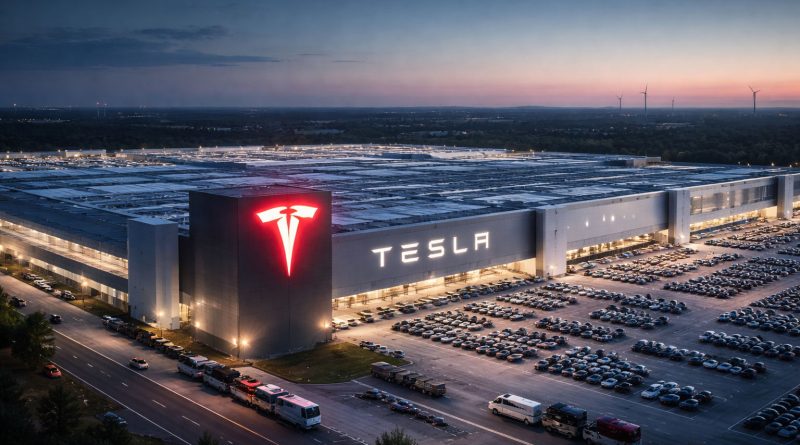
Tesla Giga Berlin to Expand Capacity to 800,000 Vehicles by 2027
Tesla plans to significantly expand its Giga Berlin factory, lifting annual vehicle production capacity to 800,000 units by 2027, according to information shared publicly by company representatives and industry sources.
The expansion will add roughly 2 million square feet of new manufacturing space and marks one of Tesla’s largest production scale-ups in Europe to date, reinforcing the company’s long-term commitment to regional manufacturing amid intensifying global EV competition.
Beyond higher vehicle output, Tesla has also confirmed plans to begin battery cell production at Giga Berlin by 2027, a move that could materially strengthen supply chain resilience and improve cost efficiency as production volumes rise.
Production Capacity and Facility Growth
The expansion adds approximately 2 million square feet of new production space to the Berlin site. As a result, annual vehicle output capacity will rise from 500,000 to 800,000 vehicles, significantly enhancing Tesla’s ability to meet European and international demand.
Industry observers note that this capacity increase elevates Giga Berlin’s strategic role within Tesla’s global manufacturing network, particularly as demand for electric vehicles continues to grow across Europe.
Battery Production and Vertical Integration
Beyond vehicle assembly, Tesla announced in December 2025 that battery cell production will begin at Giga Berlin by 2027. This marks another step in Tesla’s push toward vertical integration, aimed at reducing costs, improving supply chain resilience, and limiting reliance on third-party battery suppliers as production scales.
The move mirrors Tesla’s broader strategy of bringing critical components in-house to protect margins and improve manufacturing flexibility.
Manufacturing Innovation and Operations
Giga Berlin continues to deploy advanced manufacturing techniques, including Tesla’s rear underbody Gigacasting technology, which consolidates roughly 70 individual parts into a single aluminum casting. This innovation simplifies assembly, lowers complexity, and improves production efficiency.
By late 2025, the factory had already ramped up to two-shift operations to meet rising demand, signaling steady operational momentum ahead of the capacity expansion.
Why This Matters
Giga Berlin serves as a major export hub, shipping Model Y vehicles to more than 30 international markets. Expanding capacity to 800,000 units per year strengthens Tesla’s global distribution network while reducing its dependence on U.S.-based production.
The combination of higher output, battery integration, and manufacturing efficiency underscores Tesla’s focus on regional diversification and cost control as global EV competition intensifies.
Outlook Toward 2027
With vehicle capacity rising and battery production planned for 2027, Tesla appears to be doubling down on Europe at a critical time for the electric vehicle market. If executed effectively, vertical integration at Giga Berlin could materially improve margins while enhancing supply chain stability.
As competition accelerates and pricing pressure increases across the EV sector, the success of this expansion may play a key role in Tesla’s long-term positioning in Europe.



 English