
Claude AI Study Shows 1.8% Productivity Growth Potential
- Anthropic just dropped fresh research looking at how their Claude AI model actually impacts productivity in the real world. The study digs into how much time people save when they use Claude for everyday tasks, using actual conversation transcripts to measure the difference. They looked at various job types and tried to figure out how these time savings could ripple through the economy.
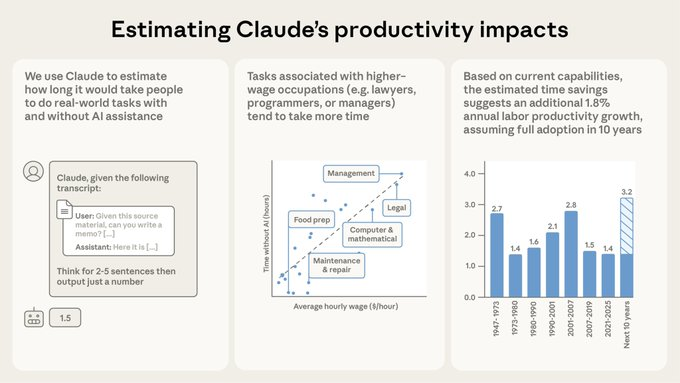
- The research shows something interesting about higher-paying jobs. Positions like management, legal work, programming, and other computer-math heavy roles naturally take longer to complete their tasks. There’s a direct connection between hourly wages and how long tasks take, which means complex professions get different benefits from AI speed-ups. Anthropic took all these individual task measurements and scaled them up to predict national productivity changes based on what Claude can do right now.
AI-driven time savings could add roughly 1.8 percentage points to annual U.S. labor productivity growth if Claude achieves full adoption over the next 10 years.
- Here’s where it gets compelling. If Claude sees full adoption over the next decade, we’re looking at about 1.8 percentage points added to yearly U.S. labor productivity growth. The study compares this to historical data, showing potential growth jumping from the usual 1-2% range up past 3%. While Anthropic’s Economic Index tracks where Claude gets used, this research zeros in on how useful it actually is for cutting down task time.
- An increase like this would be a genuine game-changer for long-term productivity patterns. When AI tools can meaningfully cut the time needed for knowledge work across the board, we’re talking about efficiency gains that could fundamentally change how work gets structured, what the economy produces, and the overall capacity of the labor force in the years ahead.
My Take: This research feels more grounded than typical AI hype. Measuring actual time savings from real conversations is smart methodology. The 1.8% figure might seem modest, but in productivity terms, that’s massive—comparable to major tech revolutions.
Source: Anthropic



 English