
US Tech Jobs Fall to 2.3% of Employment as 91,000 Positions Vanish Since 2022
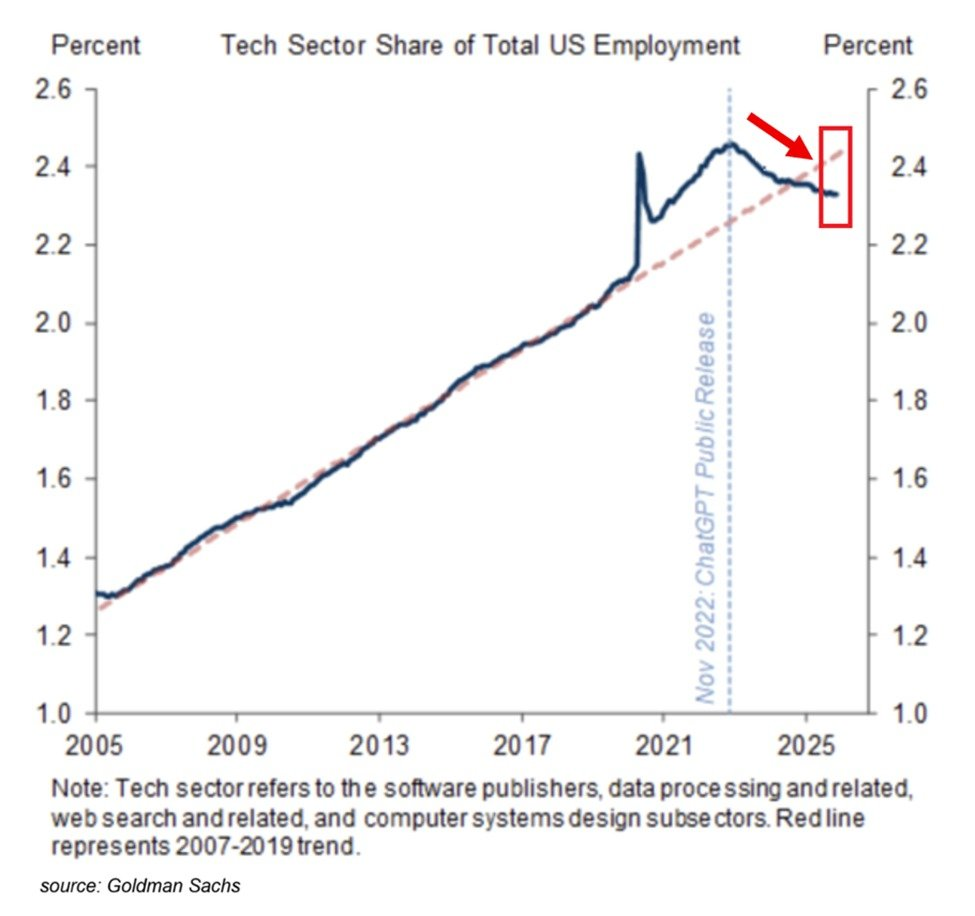
U.S. technology employment has declined to just 2.3% of total jobs in 2025, marking its lowest share since early 2021, according to industry labor data compiled by The Kobeissi Letter.
The downturn follows the sector’s hiring peak in late 2022 and has resulted in the elimination of approximately 91,000 tech positions across the U.S. economy.
The decline comes as companies increasingly adopt artificial intelligence and automation tools, allowing them to maintain productivity while reducing headcount, particularly in software and engineering roles.
Key employment data
U.S. tech employment peaked in November 2022, a period that coincided with the public rollout of advanced generative AI tools. Since then, job losses have been concentrated across several core technology industries, including computing infrastructure, data processing and web hosting, web search services, and computer systems design.
The contraction has effectively reversed nearly two decades of steady employment growth in several foundational segments of the U.S. technology sector.
Software hiring slowdown
Hiring indicators suggest the pullback is structural rather than cyclical. Software development job postings on Indeed have fallen 71% from their February 2022 peak and now sit roughly 33% below pre-pandemic levels.
This sharp decline reflects how companies are using AI-driven productivity gains to operate with smaller engineering teams, even as output and revenues remain stable or continue to rise.
Why it matters
Why it matters:
- Technology has historically been one of the largest drivers of U.S. job creation and wage growth.
- Slower tech hiring affects regional labor markets, housing demand, and consumer spending in cities heavily reliant on technology jobs.
- Unlike previous downturns, many lost roles are being replaced by automation rather than temporary layoffs.
The shift highlights a structural change in the labor market, where technology is increasingly automating tasks that once required large human teams.
Outlook
Looking ahead, continued advances in artificial intelligence and automation suggest pressure on tech employment could persist into 2026. While new roles related to AI development, oversight, and infrastructure are expected to emerge, they are unlikely to offset job losses at the same pace seen during the industry’s expansion years.
The broader challenge for the U.S. labor market is no longer whether automation will reshape white-collar work, but how quickly—and across how many sectors—that transformation will unfold.



 English