
Japan’s 10-Year Bond Yield Hits 2.17%, Highest Since 1999
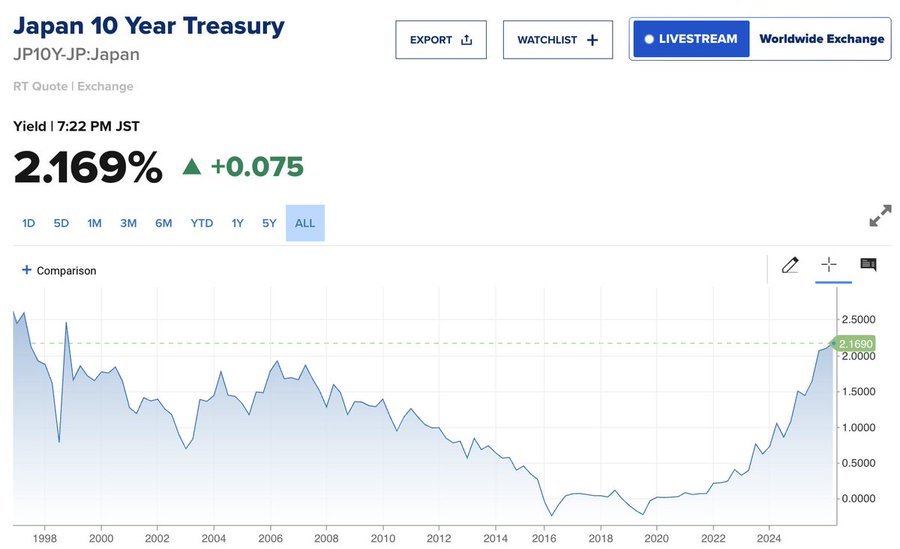
Japan’s bond market has reached a historic turning point. The country’s 10-year government bond yield climbed to 2.17%, marking its highest level in more than 25 years. The move signals a decisive shift away from the ultra-low interest rate era that defined Japan’s economy for decades.
The rise reflects changing expectations around inflation, growth, and monetary policy, as investors demand higher returns to hold Japanese government debt.
Key Developments in Japan’s Bond Market
10-Year Government Bond Yield
- Japan’s 10-year yield reached approximately 2.17%, a level last seen in the late 1990s
- The move represents a sharp break from the near-zero rate environment maintained by the Bank of Japan
- Investors are pricing in higher inflation and a sustained policy normalization
Shift in Monetary Policy Expectations
For years, Japan relied on ultra-loose monetary policy to combat deflation and stimulate growth. The surge in bond yields suggests markets now believe that:
- Deflationary pressures are no longer dominant
- Inflation risks are real and persistent
- The Bank of Japan is moving toward a more conventional policy framework
As one analyst noted, Japan has long been a global source of cheap capital, and this shift signals a broader structural transition in global monetary policy.
Domestic Impact
The effects inside Japan are already becoming visible:
- Higher yields make Japanese bonds more attractive to global investors
- Increased foreign demand tends to strengthen the yen
- A stronger yen pressures exporters such as Toyota by making exports more expensive
At the same time, borrowing costs are rising across the economy:
- Corporations face higher financing expenses
- Mortgage rates are climbing for households
- Consumers feel the squeeze amid weak domestic demand and an aging population
Global Implications
Japan has supplied the world with low-cost capital for decades. As yields rise:
- Capital may begin flowing back into Japan
- Other global markets could see reduced inflows
- The global era of ultra-loose monetary policy appears closer to its end
This development reinforces the idea that even the most accommodative central banks can no longer ignore inflation.
Outlook and What Comes Next
If Japanese yields continue to rise:
- The yen could strengthen further
- Global bond markets may face renewed pressure
- Japan’s policy shift could accelerate monetary tightening elsewhere
Much will depend on how the Bank of Japan balances inflation control with the risk of slowing economic growth.



 English