
US Inflation Falls to 0.93% as Real-Time Data Signals Cooling
Inflation in the United States appears to be cooling faster than many traditional indicators suggest. Real-time economic data is increasingly offering a clearer and more immediate picture of price movements across the economy. One of the latest readings from Truflation shows that inflation has dropped well below the Federal Reserve’s long-standing 2% target, raising new questions about the direction of consumer prices and the broader economic outlook.
Real-Time Inflation Data Shows Sharp Slowdown
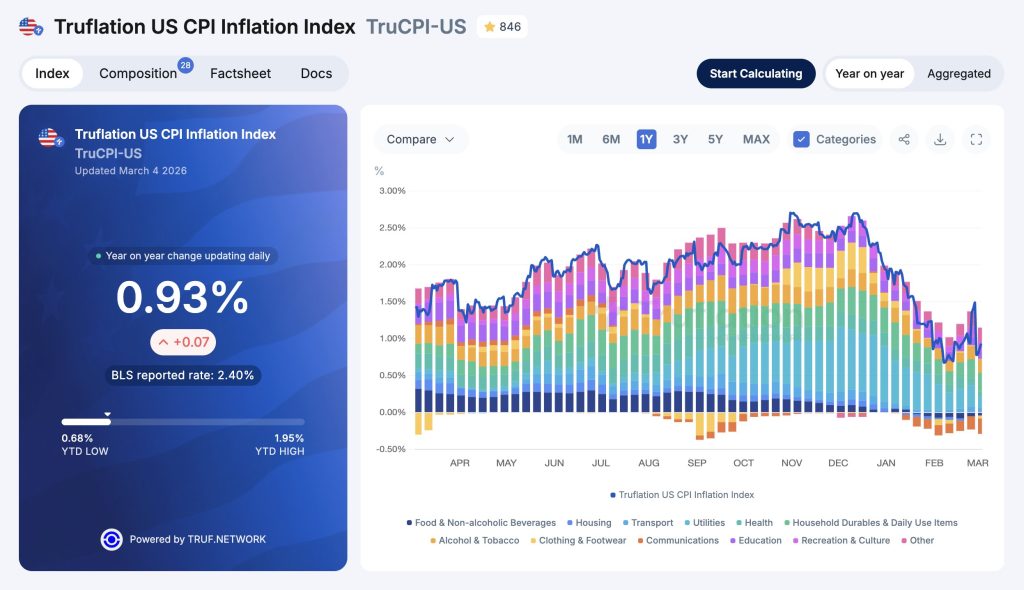
Real-time inflation tracking platform Truflation reports that US headline inflation has dropped to 0.93% year-over-year, significantly below the Federal Reserve’s long-term 2% target. The reading is calculated from millions of live transaction data points across the economy, offering a faster view of price movements than traditional government statistics.
Unlike official CPI data that is released on a monthly basis, Truflation monitors price changes continuously using live feeds from retailers, merchants, and digital marketplaces. This real-time methodology allows analysts to detect daily changes in consumer prices rather than waiting weeks for official updates. As a result, emerging inflation or deflation trends can be identified earlier than through traditional measurement systems.
Several Consumer Categories Enter Deflation
The latest data suggests that price pressures are easing across multiple consumer sectors. According to the dataset, several categories have entered mild deflation territory.
Communications services such as mobile data packages have shown noticeable price declines. Some segments of food and apparel have also moved lower, reflecting moderating consumer demand and improving supply chain stability in certain retail areas.
These shifts suggest that parts of the consumer economy may already be experiencing disinflationary pressure even while broader macroeconomic indicators remain mixed.
Why Daily Inflation Readings Can Be Volatile
Truflation notes that daily fluctuations are normal when measuring a year-over-year inflation index on a daily basis. The system compares current prices with those from the exact same calendar date one year earlier.
Because of this methodology, short-term volatility can appear larger than in traditional monthly reports. However, the benefit of real-time monitoring is the ability to analyze detailed category data and identify which sectors are driving price movements as they happen.
Broader Economic Context
The latest inflation data fits into a larger discussion about the trajectory of the US economy. Earlier analysis in US inflation drops to 0.99% as real-time data shows deflation across key consumer categories highlights similar real-time signals suggesting cooling price pressures across several consumer sectors.
At the same time, growth momentum is slowing according to US GDP slows to 1.4% in Q4 2024 as PCE inflation accelerates to 2.9%, while longer-term projections described in U.S. GDP growth slows to 2.2% in 2025, weakest expansion in four years point to a broader deceleration in economic expansion.
What It Could Mean for Federal Reserve Policy
If the disinflation trend continues, it could reshape expectations around future Federal Reserve policy decisions. Persistently low inflation readings may increase market speculation about when interest rate adjustments could occur.



 English