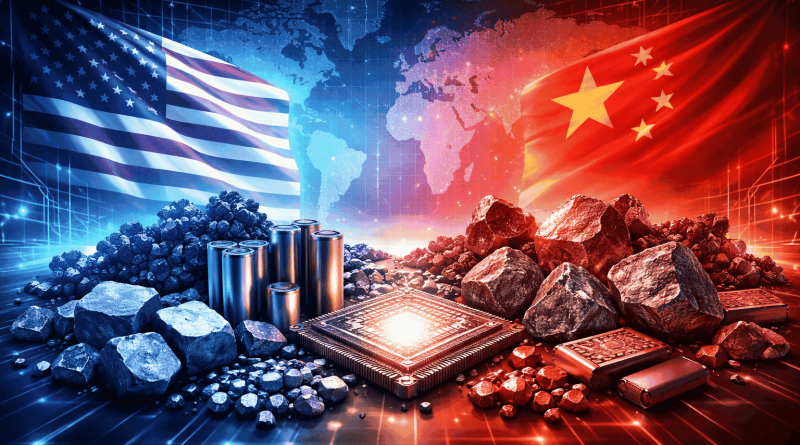
Critical Minerals News: Global Economy Enters Cold War 2.0
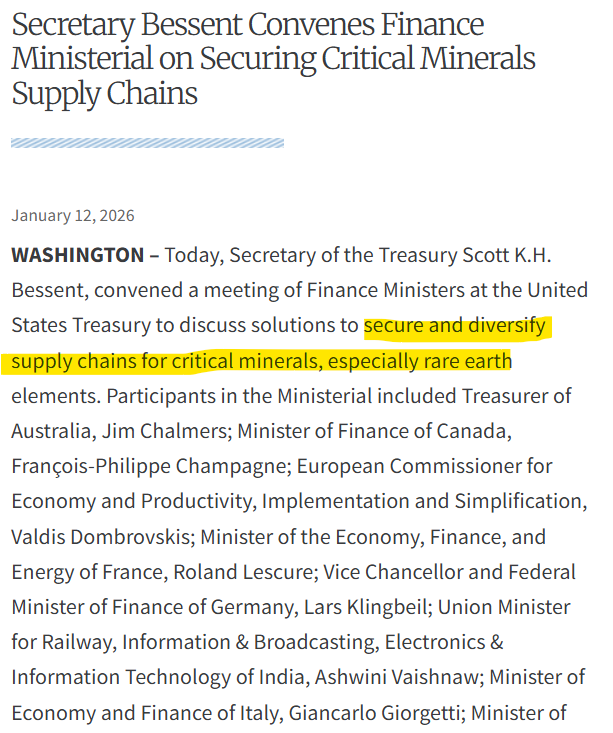
The global economy is entering what analysts increasingly describe as “Cold War 2.0,” a new phase of strategic competition defined not by military confrontation, but by control over critical minerals and industrial supply chains. This shift is becoming evident in high-level policy discussions, including recent coordination among finance ministers focused on reducing structural vulnerabilities tied to resource dependency.
Key Developments in the Global Economy
Supply Chains as the New Measure of Power
Economic power is no longer determined primarily by capital markets, financial dominance, or military scale. Instead, it is increasingly shaped by access to critical minerals, refining capacity, and control over industrial chokepoints that determine whether economies can maintain production and stability during periods of geopolitical stress. This marks a fundamental change in how governments assess economic strength and national security.
China’s Long-Built Industrial Advantage
Over several decades, China has systematically constructed dominance across the full downstream industrial stack, spanning mining, processing, refining, and manufacturing. This comprehensive integration has resulted in widespread global dependence on Chinese inputs. As a consequence, supply chains have evolved from neutral economic infrastructure into tools of geopolitical leverage, capable of influencing global industrial output.
Why This Matters
The growing policy focus on critical minerals reflects recognition that decades of market-driven globalization have produced strategic vulnerabilities. Governments are increasingly moving away from the assumption that markets alone can allocate capital efficiently in all circumstances. Instead, supply chain security is being treated as a strategic objective, even when it conflicts with short-term profitability.
As one recent analysis noted, this emerging conflict “will not be defined by missile counts, but by control over supply chains.” Reversing long-standing dependencies is likely to require sustained policy intervention and a reorientation of investment priorities toward strategic independence.
Outlook: A Structural Transition
The shift away from hyper-globalization is already underway. Allied economies are expanding coordination around sourcing, processing, and industrial policy in order to reduce exposure to concentrated supply chains. This transition represents a clear departure from decades of cost-optimization and efficiency-driven globalization toward a framework centered on resilience, redundancy, and strategic control.
Implications for Markets and Capital Allocation
As this transformation accelerates, capital flows are increasingly aligning with sectors tied to strategic security rather than purely financial returns. Commodities, critical minerals, and downstream industrial capacity are becoming central components of long-term economic planning. As a result, critical minerals news is no longer a niche policy topic but a core pillar of global economic strategy that will shape investment decisions for years.

 English