
XLM News: Stellar Expands Tokenized Government Debt Market
Tokenization of real world assets continues to reshape traditional finance, and the Stellar network is becoming one of the blockchains actively supporting this transition. As financial institutions explore blockchain settlement layers, government debt instruments are increasingly moving on chain. This trend highlights how networks like Stellar are evolving beyond payments into infrastructure for tokenized financial products.
Stellar Expands Tokenized Sovereign Debt Beyond U.S. Markets
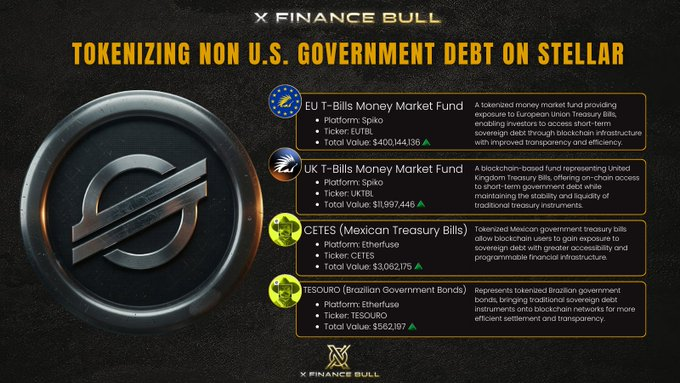
The Stellar (XLM) blockchain is gaining traction as a platform for tokenized sovereign debt as financial firms expand beyond U.S. Treasury products into European and Latin American government instruments. Tokenized government securities now include more than $400 million in EU Treasury bills, alongside smaller allocations from UK, Mexican, and Brazilian sovereign debt.
The expansion reflects how blockchain infrastructure is increasingly being tested as a settlement layer for traditional financial assets and real world asset tokenization. The development also comes as market participants monitor Recent Stellar price momentum following technical breakouts.
Institutional Platforms Driving Government Bond Tokenization
Data presented shows that platforms such as Spiko and Etherfuse are helping move government bonds onto blockchain networks. EU T-Bills represent the largest share at more than $400 million, followed by UK Treasury exposure of about $12 million, Mexican CETES around $3 million, and Brazilian sovereign bonds exceeding $500,000.
This growth mirrors broader industry trends as financial institutions experiment with blockchain to improve efficiency, transparency, and settlement speed. At the same time, traders continue watching XLM price consolidation near key technical levels as the ecosystem develops.
How Stellar Infrastructure Supports Tokenized Assets
The technical structure behind these tokenized assets relies on Stellar’s infrastructure, where transactions require the XLM token to process network fees. As more tokenized instruments are issued, overall network usage could increase alongside transaction activity.
The evolution of Stellar’s ecosystem also reflects growing interest in real world asset tokenization across financial markets. This aligns with discussions about Bullish technical setups forming for Stellar as adoption metrics and technical structures continue to develop.
Blockchain Integration Into Traditional Finance
The broader implication is that blockchain networks such as Stellar are gradually becoming part of the infrastructure layer supporting traditional financial products. As more sovereign debt instruments move on chain, adoption will likely depend on regulatory clarity, institutional demand, and operational reliability.
The continued growth of tokenized government debt may therefore serve as an indicator of how quickly blockchain networks like Stellar integrate into global capital markets and whether tokenization becomes a permanent component of financial market infrastructure.
My Take: Stellar’s tokenized debt push looks real. $400M+ in EU T-Bills is no pilot. If regulatory friction stays low, XLM’s utility case gets much harder to dismiss.
Source: Twitter Post by X Finance Bull

 English