WTI and Brent Hit Highest Levels Since Mid-November as Oil Rally Tests $65–$70 Resistance
Oil markets have recently shown renewed strength, with both WTI and Brent crude futures rising toward their best levels since mid-November. While traders had largely anticipated oversupply pressures throughout 2025 and early 2026, the lack of a deep price collapse has forced many bearish positions to unwind. At the same time, rising geopolitical tensions, especially regarding Iran and other regions, have added a risk premium to energy markets.
Main Oil Market Developments
Crude Price Action and Resistance Tests
Recent price movements show crude benchmarks attempting to break higher:
- WTI prices pushed toward the $60 – $62 range, approaching important resistance just above.
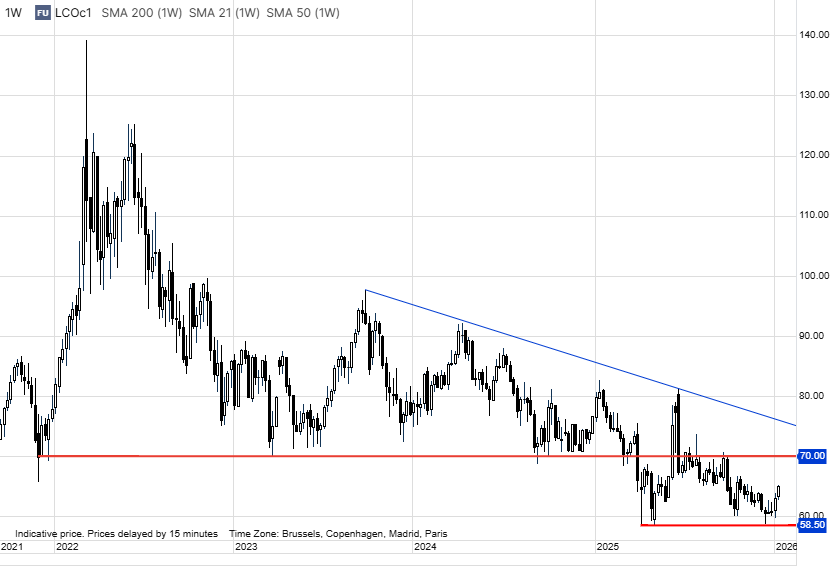
- Brent was trading near $63 – $64 per barrel, with the $65-$70 zone seen as key overhead resistance that has constrained sustained rallies.
- The spread between Brent and WTI remains consistent with historical norms, reflecting different sensitivities to global trade and supply.
Analysts note that prices have moved mostly on market positioning and risk sentiment rather than a sudden shift in actual supply and demand. While short covering and headline news have driven technical strength, breaking past the $65-$70 range would require clearer signs of a tightening market or major disruptions.
Supply, Demand, and Technical Trends
Global markets continue to reflect a comfortable supply-demand balance in many forecasts, even as geopolitical risk premiums wax and wane. While some analysts see continued oversupply pressures through 2026, others anticipate periodic price lifts based on events such as political instability or export sanctions.
Technical charts also highlight the importance of the mid-$60s as a resistance cluster, where major moving averages and sentiment indicators have capped gains in recent sessions. Breaking decisively above this zone could signal a shift from rangebound behavior to broader bullish momentum.
Why This Matters
The recent rebound in crude prices reveals several key dynamics in the oil market:
- Market psychology matters: Prices have responded sharply to headlines and positioning flows even when fundamental supply/demand indicators remain balanced.
- Geopolitical risk affects risk premia: Concerns about Iran and broader Middle East tensions have lifted prices modestly, suggesting traders still price in potential supply uncertainty.
- Resistance zones are technical and psychological: The $65-$70 area has proven difficult for both WTI and Brent to sustain above, limiting the ability of rallies to convert into longer-term uptrends.
Despite these factors, underlying fundamentals such as inventories, production levels, and global supply growth have not dramatically shifted to justify a sustained breakout above current resistance.
Outlook and Forecasts
Looking ahead:
- Most analysts expect oil prices to remain rangebound unless there is a sizable, sustained disruption to global supply. Structural metrics continue to point toward balanced or slightly oversupplied conditions into 2026.
- If geopolitical risks intensify — especially around Iran, Venezuela, or other major producers — premiums could again push prices toward or above the upper resistance near $70.
- Seasonal demand changes, OPEC+ policy decisions, and U.S. inventory data will remain key drivers influencing whether crude breaks out of the current trading band.



 English