
Palladium Finds Support at 50-Day Moving Average After January Pullback
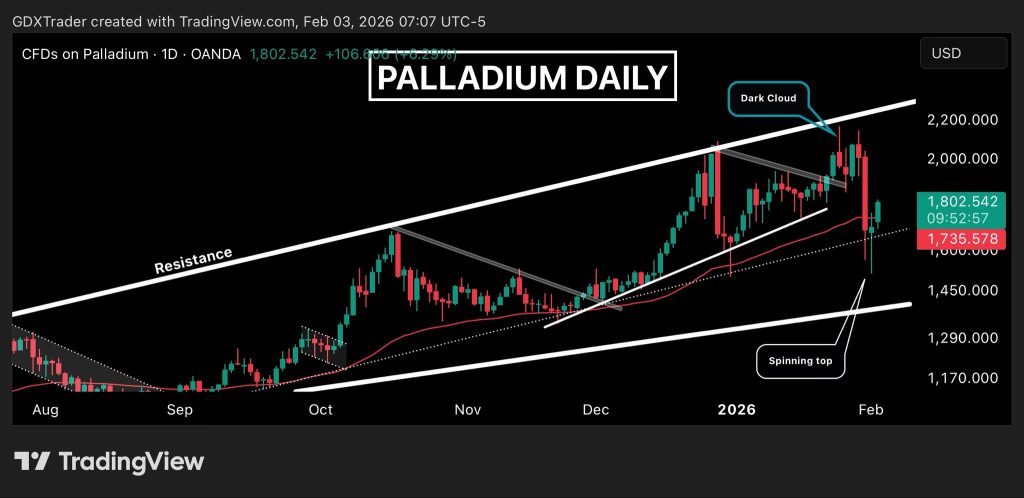
Palladium has entered a consolidation phase after pulling back from its late January highs. The metal encountered resistance on January 26, triggering a corrective move that has now found support at a key technical level. Price action following the decline suggests that buyers remain active beneath the market, even as volatility increases.
The recent pullback aligns closely with prior technical expectations, reinforcing the importance of trend structure and moving-average support in the current setup.
Key Technical Developments
Price Action and the 50-Day Moving Average
After rejecting from ascending resistance, palladium declined toward its 50-day moving average, a level that has historically acted as dynamic support within the broader uptrend. During the test, prices briefly dipped below the average before reversing sharply higher.
The session produced a candle with a long lower wick, signaling a failed breakdown. Sellers attempted to push prices lower but were unable to maintain control, allowing buyers to quickly reclaim the 50-day level.
As noted in the analysis, the spinning-top candle structure highlights a temporary loss of downside momentum and a swift defense of a critical support zone.
Volatility and Market Structure
Following the rebound, palladium has stabilized above the 50-day moving average. At the same time, daily price ranges have expanded, indicating rising volatility. This behavior is consistent with a broadening wedge formation, where price swings grow larger as the structure develops.
While the metal remains in an upward trend, it is no longer moving in a smooth, directional manner. Instead, palladium is oscillating within a widening range, increasing the importance of clearly defined support and resistance levels.
Why This Matters
The clean defense of the 50-day moving average is a notable technical signal. When a key level is tested and rapidly reclaimed, it often becomes a launch point for the next directional move. This suggests that underlying demand remains intact despite recent weakness.
However, the expansion in volatility means that price movement is becoming less predictable. Traders can no longer rely on shallow pullbacks alone, as swings in both directions are becoming more pronounced.
Outlook
If palladium continues to hold above the 50-day moving average, the technical structure favors a potential move back toward the upper resistance zone. The broader uptrend remains valid, but participation now requires greater discipline due to wider price fluctuations.
The failed breakdown attempt suggests that sellers lack follow-through momentum, keeping the path of least resistance tilted higher for now.
Analyst Perspective
The most constructive signal in this setup is the failure to sustain a break below the 50-day moving average. When sellers cannot capitalize during a pullback within an established uptrend, it often indicates that buyers remain in control beneath the surface.
As long as palladium holds above this key moving average, the broader bullish structure remains intact, even as volatility continues to expand.
Source: Trader



 English