
Gold Volatility Hits 1983 Levels as XAU Price Swings Echo Weimar Era Patterns
Gold is once again at the center of global market discussions after a sharp rise in volatility triggered comparisons with historical periods of monetary instability. Following its largest weekly decline in decades, analysts are shifting their focus from simple price direction toward volatility structure, which may reflect deeper macroeconomic uncertainty affecting financial markets.
As investors navigate inflation risks, central bank policies, and geopolitical uncertainty, gold continues to act as a key barometer of market stress. The latest volatility spike suggests that structural market pressure may be building beneath the surface.
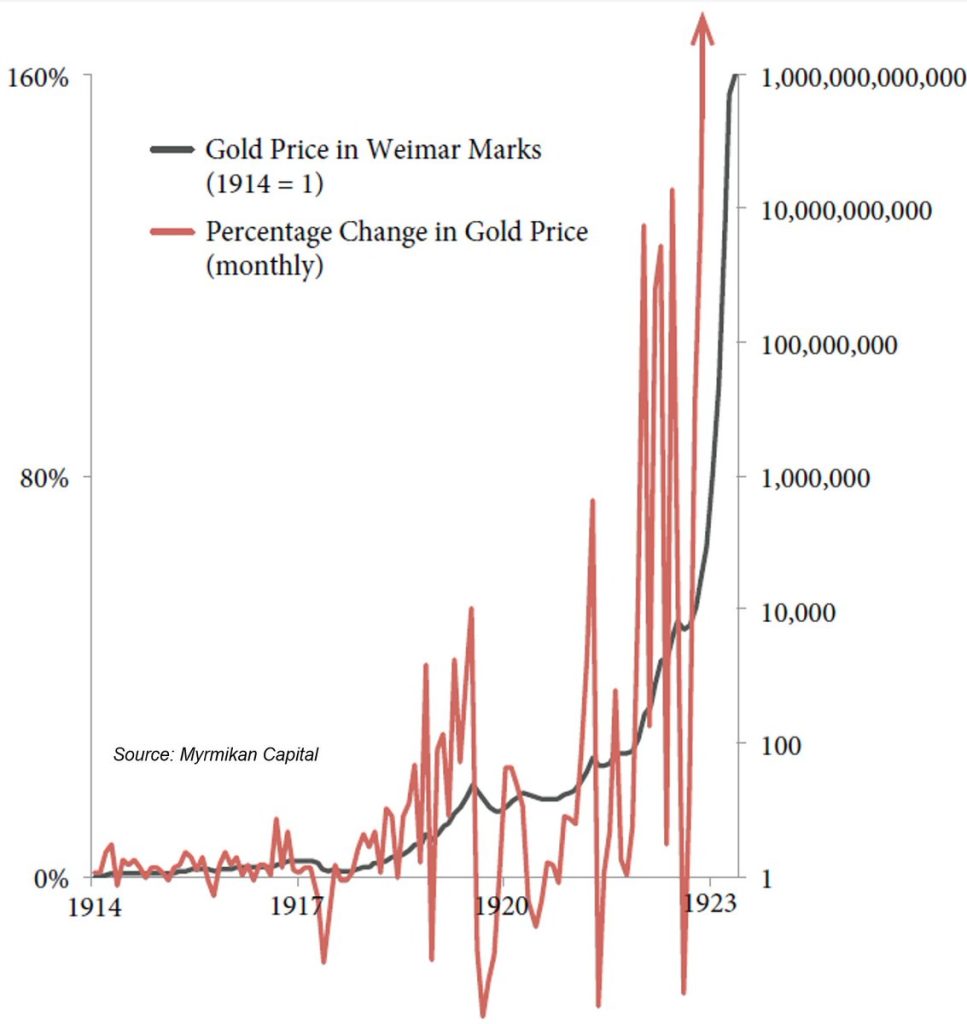
Gold drew significant market attention this week after recording its biggest weekly drop since 1983, while volatility patterns sparked discussion among analysts and institutional traders. Market analyst Luke Gromen highlighted an interesting observation. Recent price swings in gold denominated in U.S. dollars are beginning to resemble volatility behavior seen during the Weimar Republic monetary crisis. Importantly, the comparison focuses on volatility structure rather than absolute price levels.
The historical chart referenced by Gromen tracks gold priced in German marks between 1914 and 1923, a period defined by extreme currency instability. During that era, gold experienced dramatic nominal price increases while also showing sharp percentage fluctuations on a monthly basis. This historical behavior suggests that monetary stress often manifests through volatility expansion rather than through clean directional trends.
“Recent volatility in gold priced in U.S. dollars is showing characteristics similar to historical volatility observed during the Weimar Republic monetary crisis.”
The analysis comes after gold experienced a sharp volatility spike following a steep weekly decline near the $4,500 level. What stands out is not necessarily whether gold moves higher or lower next, but how volatility behaves under continued macroeconomic pressure. Similar volatility-focused discussions can also be seen in analysis of central bank gold accumulation trends, where institutional buying often reflects defensive positioning during uncertain economic cycles.
Current gold market structure shows how volatility can become the dominant narrative during periods of financial instability. Traders frequently rely on historical comparisons like this to better understand how assets behave during turbulent environments. Gold continues to function as a benchmark safe-haven asset when confidence in traditional financial systems weakens. At the same time, the gold technical trend outlook suggests that structural price movements are often driven more by volatility cycles than by stable long-term trends.
Historical volatility comparisons provide useful context but should not be viewed as predictions. The Weimar comparison highlights similarities in volatility behavior during periods of financial stress rather than suggesting a repeat of historical events. Current gold price swings are more likely reflecting macroeconomic uncertainty than signaling a return to hyperinflation conditions seen in the early twentieth century.
Source: Twitter post by Luke Gromen



 English