
Gold Price Near $5,000 as Psychological Pressure Intensifies
Gold is approaching the critical $5,000 price level, a milestone that often reshapes market behavior more through psychology than through fundamentals. Recent price action shows a sharp, near-vertical advance, placing gold in a late-stage momentum phase where emotions increasingly influence investor decision-making. At these levels, the market’s focus shifts from valuation to positioning, risk control, and behavioral responses.
Key Market Signals
Price Structure and Momentum
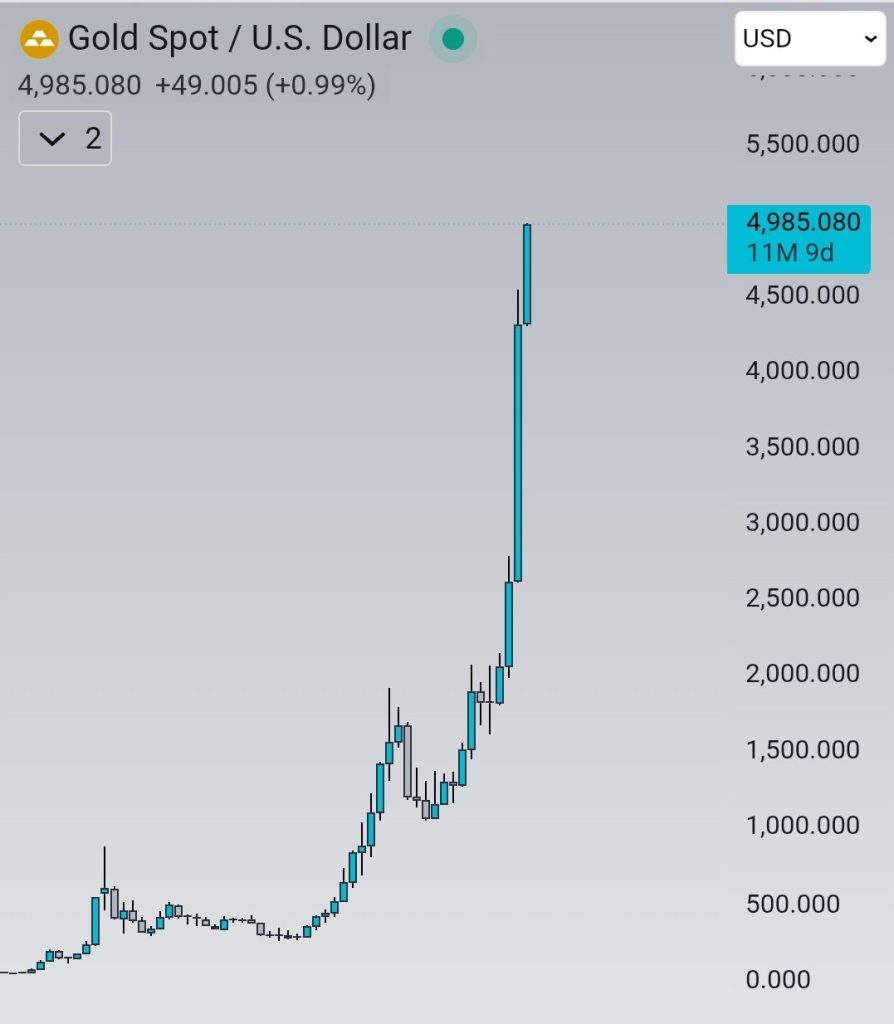
Gold’s rapid advance into the $5,000 zone reflects strong momentum and sustained demand. The steep trajectory suggests that price has entered an accelerated phase, where trends can extend quickly but also become more fragile. Such vertical moves tend to compress decision-making time and increase sensitivity to shifts in sentiment.
Psychological Dynamics at Record Highs
When an asset reaches new all-time highs, two dominant emotions typically emerge:
- Greed, as early participants consider locking in profits
- Fear of missing out (FOMO), as late buyers rush to gain exposure
This combination often leads to crowded positioning and heightened volatility. Even within strong long-term uptrends, these dynamics increase the probability of sharp pullbacks or sudden pauses as positioning becomes imbalanced.
Why This Matters for Gold Investors
At record levels, the primary risk becomes behavioral rather than structural. Gold’s long-term trajectory may remain constructive, but the short-term risk-reward profile deteriorates as price accelerates. Buying near historic highs is not inherently wrong, but it becomes dangerous when driven by urgency instead of defined risk parameters.
As liquidity tightens during parabolic advances, even modest changes in sentiment can trigger outsized price moves. Smart capital focuses less on predicting immediate upside and more on understanding downside exposure if momentum fails.
Risk Management and Alternative Approaches
During late-stage rallies, many market participants shift away from aggressive entries and toward defensive positioning strategies, including:
- Waiting for consolidation instead of chasing price
- Reducing position size to manage volatility
- Using dollar-cost averaging rather than full exposure at once
These approaches allow continued participation in the trend while limiting downside risk if momentum stalls or reverses.
Outlook Near the $5,000 Level
Historically, parabolic moves across asset classes often pause or retrace to reset positioning. Such pauses do not invalidate the broader trend but test discipline and patience. As gold hovers near $5,000, opportunity remains present, but so does elevated risk. Price behavior around this level is likely to remain volatile as the market processes gains and reassesses positioning.



 English