US Job Cuts Jump 118% in January 2026 as AI Accounts for 7% of Layoffs
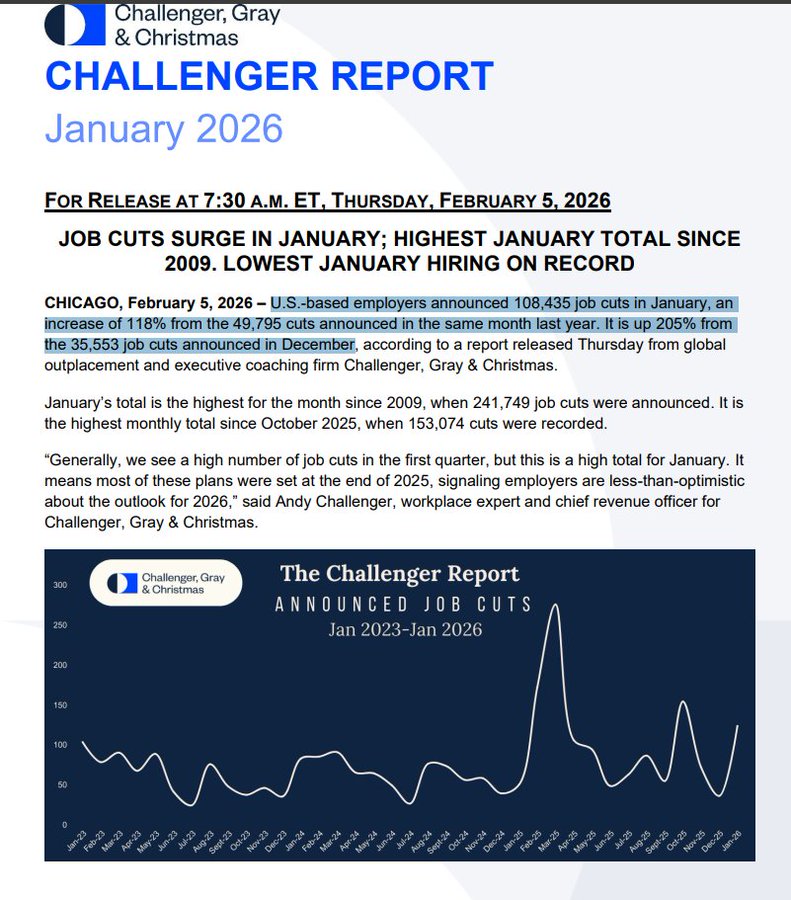
US companies began 2026 with an aggressive wave of job cuts, marking the fastest January pace in more than 15 years. According to data from Challenger, Gray & Christmas, employers announced 108,435 layoffs in January alone, highlighting mounting economic pressure and the growing role of automation in corporate restructuring.
Key Layoff Data From January 2026
Scale of Job Cuts
- Total layoffs: 108,435
- Year-over-year increase: +118% compared with 49,795 cuts in January 2025
- Month-over-month increase: +205% from December’s 35,553 layoffs
January typically brings elevated workforce reductions as companies finalize year-end decisions, but the scale of these cuts stands out as unusually severe. It represents the highest January total since the 2009 financial crisis and the largest single-month figure since October 2025.
AI-Driven Layoffs
A defining feature of this layoff wave is the explicit role of artificial intelligence. Employers cited AI-related automation in 7,624 job cuts, accounting for roughly 7% of all announced layoffs.
Challenger emphasized that its data only captures publicly disclosed reasons, suggesting the true impact of AI-driven workforce reductions may be significantly larger. The willingness of companies to openly attribute job cuts to AI marks a shift in how technological adoption is reflected in labor data.
Why This Matters
This round of layoffs differs from past cycles because technology is no longer a background efficiency tool—it is now a direct driver of headcount reduction. The combination of surging job cuts and AI-related displacement introduces new uncertainty into the economic outlook.
If layoffs persist beyond typical seasonal patterns, they could weigh on consumer spending, business confidence, and future hiring. At the same time, automation-driven restructuring is becoming a structural feature of the labor market rather than a temporary adjustment.
Outlook for 2026
Looking ahead, the labor market faces dual pressures: cyclical economic uncertainty and long-term structural change driven by automation. If companies continue to cite AI as a reason for workforce reductions, employment growth in 2026 may look fundamentally different from prior recoveries.
The January data suggests that job displacement tied to artificial intelligence is moving from theory to measurable reality—and may accelerate as the year progresses.
Source:Rohan Paul



 English