
OpenAI’s $110B Funding Round Matches Unprecedented Cash Burn Through 2030
OpenAI has secured approximately $110 billion in new funding, marking one of the largest capital raises in technology history. The round, reportedly backed by Amazon, Nvidia, and SoftBank, dramatically expands the company’s financial war chest as it accelerates large-scale AI model development and global infrastructure expansion.
The raise nearly triples OpenAI’s cumulative funding and solidifies its position at the top of the AI capital hierarchy. Yet the scale of this financing comes with a striking caveat: internal projections suggest the company’s spending trajectory could consume most of these resources by 2030.
For deeper context, see OpenAI funding news
The Funding Surge in Context
Data highlighted by Epoch AI shows OpenAI’s cumulative funding curve rising sharply into 2026, widening the gap between the company and competitors such as Anthropic, xAI, and Mistral AI.
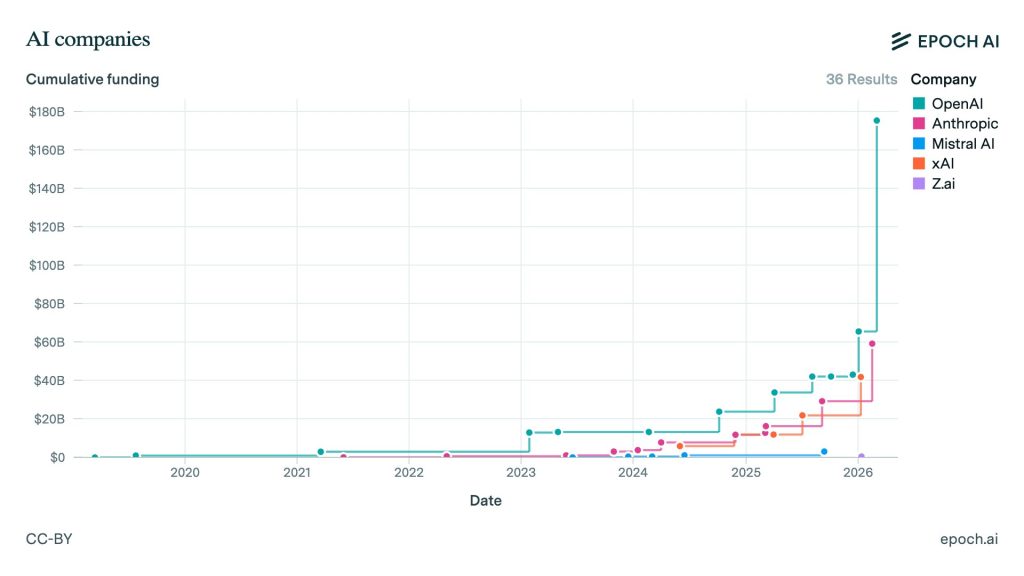
This is not merely symbolic leadership. The capital reflects escalating costs associated with frontier AI development, including advanced model training, inference infrastructure, and global data center expansion.
The widening disparity suggests that competing at the highest tier of AI research increasingly requires capital intensity comparable to large-scale infrastructure programs. A broader breakdown of the competitive landscape is available in AI company funding comparison
What was once a sequence of incremental funding rounds has evolved into a race defined by balance sheet scale.
Spending Projections Through 2030
Despite the record raise, OpenAI’s projected expenditure curve is equally historic. Estimates indicate that cumulative spending on compute, AI model training, inference capacity, semiconductor supply, and data center buildouts could reach the high hundreds of billions of dollars by the end of the decade.
Analysts suggest the company may not achieve positive cash flow until close to 2030, implying multiple years of operating losses even after securing unprecedented capital backing.
Detailed projections and analysis can be found in AI cash burn projections
The contrast between record fundraising and record cash burn underscores how capital-intensive frontier AI has become. The scale required to remain competitive would have appeared unrealistic only a few years ago.
Diverging Strategies in the AI Sector
While OpenAI is aggressively scaling infrastructure and pursuing dominance through compute expansion, other AI developers are taking more measured approaches. Some competitors, including Anthropic, have publicly emphasized earlier paths to profitability and tighter capital discipline.
This divergence reveals a structural split in AI strategy:
- One model prioritizes scale, rapid expansion, and compute dominance.
- The other emphasizes sustainability, cost control, and incremental growth.
How these strategies perform under market pressure will influence the long-term shape of the AI industry.
Why This Matters
OpenAI’s funding trajectory highlights a fundamental transformation in AI economics. Frontier development is no longer accessible to moderately funded startups. It increasingly requires extraordinary financial backing, narrowing the competitive field to a small number of heavily capitalized firms.
The combination of record fundraising and aggressive projected spending raises a central question: can capital deployment at this scale remain sustainable if revenue growth lags infrastructure investment?
The answer will determine whether the current AI boom evolves into durable dominance or structural fragility.
My Take
This funding round confirms that leadership in advanced AI is now tied directly to access to massive capital pools. However, scale cuts both ways.
While unprecedented funding strengthens OpenAI’s competitive moat, matching it with equally unprecedented cash burn introduces long-term structural risk. The key issue is not whether OpenAI can raise additional funds. It is whether the pace of spending can translate into defensible revenue streams before capital intensity becomes a constraint.
The next several years will test whether frontier AI economics reward aggressive expansion or disciplined execution.
Source: Epoch AI



 English