Grok AI Scores 44% on CryptoBench, Outperforms Major Models
- Grok just claimed the number one spot on CryptoBench, becoming the first AI agent to lead this specialized benchmark built specifically for crypto market operations. CryptoBench measures how well AI systems handle real-time market data pulls, price forecasting, on-chain analytics, and DeFi risk detection—all critical functions in today’s fast-moving digital asset space.
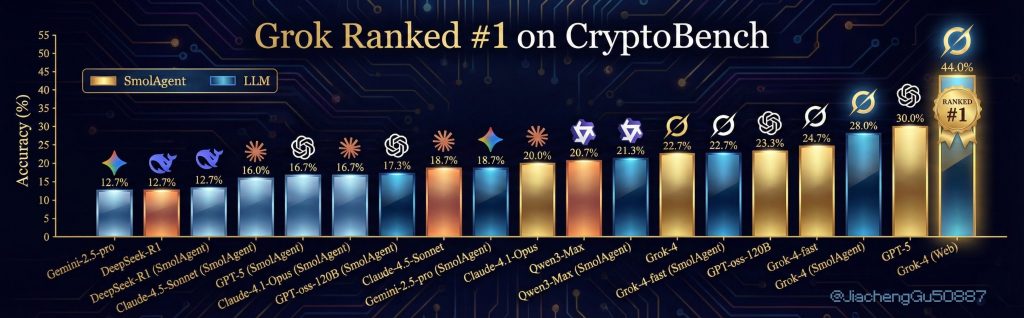
- The results show Grok hitting 44 percent accuracy, putting significant distance between itself and competing systems like SmolAgent and various LLM-based models. That score might not sound massive at first glance, but it’s actually double or triple what most general-purpose AI models managed on the same tests. Claude, Gemini, GPT variants, Qwen, and DeepSeek mostly landed in the 12 to 30 percent range, highlighting just how much specialization matters when you’re dealing with crypto’s unique data environment.
- What makes this benchmark different is its focus on operational tasks rather than conversation quality. It tests whether an AI can actually process chain-level data, interpret volatility signals, and map out risk scenarios in decentralized protocols. Grok’s performance suggests it’s been optimized specifically for these functions, giving it a clear edge over models designed for broader use cases.
“The competitive landscape among AI models is rapidly shifting toward specialized agents rather than general-purpose conversational systems,” industry observers noted, pointing to Grok’s results as evidence of this trend.
- The practical implications are pretty straightforward. Traders, developers, and automated systems increasingly rely on AI for decision support, and Grok’s accuracy positions it as one of the strongest tools available for assessing market structure and volatility drivers. As these systems get better at integrating complex real-time signals, their influence across trading strategies, blockchain analysis, and risk management will only expand.
- The benchmark results underscore a broader shift: AI in crypto isn’t just about answering questions anymore. It’s about processing massive data streams, identifying patterns in decentralized systems, and delivering actionable insights under pressure. Grok’s lead on CryptoBench shows that specialized training beats general capability when the stakes involve real capital and real-time market conditions.
My Take: Grok’s 44% might seem modest, but context matters—crypto data is messy, fast, and unforgiving. Doubling the competition’s score shows specialization wins. The real question is whether this accuracy translates to actual trading edge or just benchmarking flex.
Source: tetsuo

 English