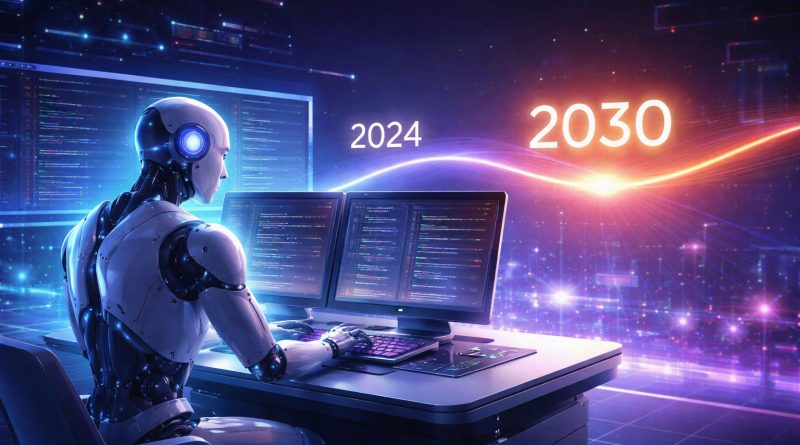
Autonomous AI Coding Now Expected Around 2030, Researchers Say
Fully autonomous AI coding systems are now expected to arrive closer to 2030, not 2027, according to researchers tracking real-world AI coding performance. New data suggests that while AI models continue to improve at handling long-horizon coding tasks, progress is unfolding through steady, incremental gains rather than rapid breakthroughs.
The revised timeline is based on performance tracking from organizations such as METR, which monitor how modern AI systems perform on increasingly complex, multi-hour coding assignments. While current models show strong improvements compared with earlier generations, researchers say the pace of advancement no longer supports earlier, more aggressive forecasts.
The shift has meaningful implications for markets and technology planning, as expectations around autonomous coding have been closely tied to projections for productivity growth, AI-driven efficiency gains, and long-term investment returns.
Key Findings from Recent Research
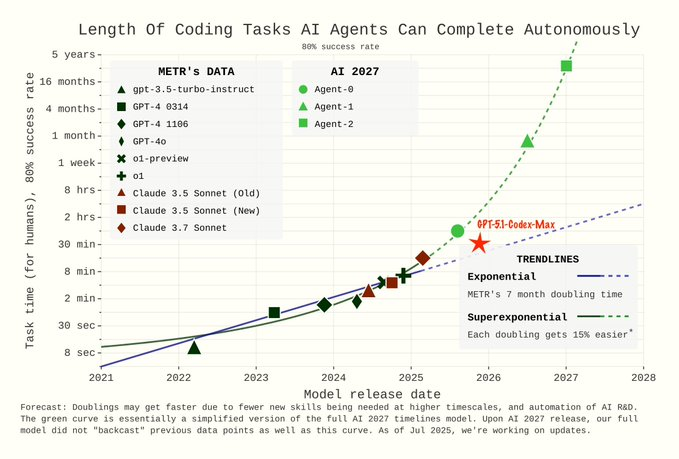
The performance data is primarily drawn from evaluations conducted by METR, a research group focused on measuring long-horizon AI task reliability.
AI Coding Capability Progress
Data tracked by METR shows clear improvement in how AI systems handle complex coding tasks:
- Early models struggled with tasks lasting seconds or minutes
- Current systems can successfully complete multi-hour coding tasks
- Success rates for long-horizon tasks now reach around 80%
However, the overall progress curve reveals a steady climb, not an exponential surge. Improvements are consistent, but breakthroughs large enough to unlock full autonomy remain elusive.
Revised Timeline for Autonomous Coding
Researchers now emphasize that gains in AI coding ability are happening through incremental improvements, rather than sudden leaps. As one analysis notes, meaningful progress continues, but without the dramatic acceleration many expected.
Technical and Scaling Challenges
The original vision—outlined by initiatives such as the AI Futures Project—suggested that autonomous coding could trigger rapid compounding progress across AI systems. In practice, scaling autonomy has introduced new layers of complexity:
- Managing long-term planning and error correction remains difficult
- Larger systems introduce coordination and reliability challenges
- Breakthrough moments are arriving slower than hype-driven forecasts predicted
These realities are pushing expectations further out.
Market and Investment Implications
For traders, investors, and policymakers, AI timelines are not academic—they directly influence capital allocation and strategic planning. Expectations around autonomous coding affect:
- Infrastructure investment decisions
- Productivity and efficiency forecasts
- Policy and regulation planning
- Long-term return-on-investment assumptions
With autonomous coding now projected closer to 2030, markets may need to recalibrate assumptions about how quickly AI-driven transformation will materialize across industries.
Outlook Toward 2030
The shift from a 2027 to a 2030 timeline suggests a future defined by gradual capability expansion, not sudden disruption. AI will continue improving, but transformative autonomy may arrive later—and more unevenly—than originally expected.
My Take
The move from 2027 to 2030 matters more than it appears. Markets priced in rapid AI-driven productivity gains, but incremental progress implies slower realization of returns and longer timelines for impact. Expectations—and investment strategies—should adjust accordingly.
Sources:
- Research insights referenced by METR
- Analysis aligned with the AI Futures Project
- Source commentary: Twitter post by Hedgie

 English